
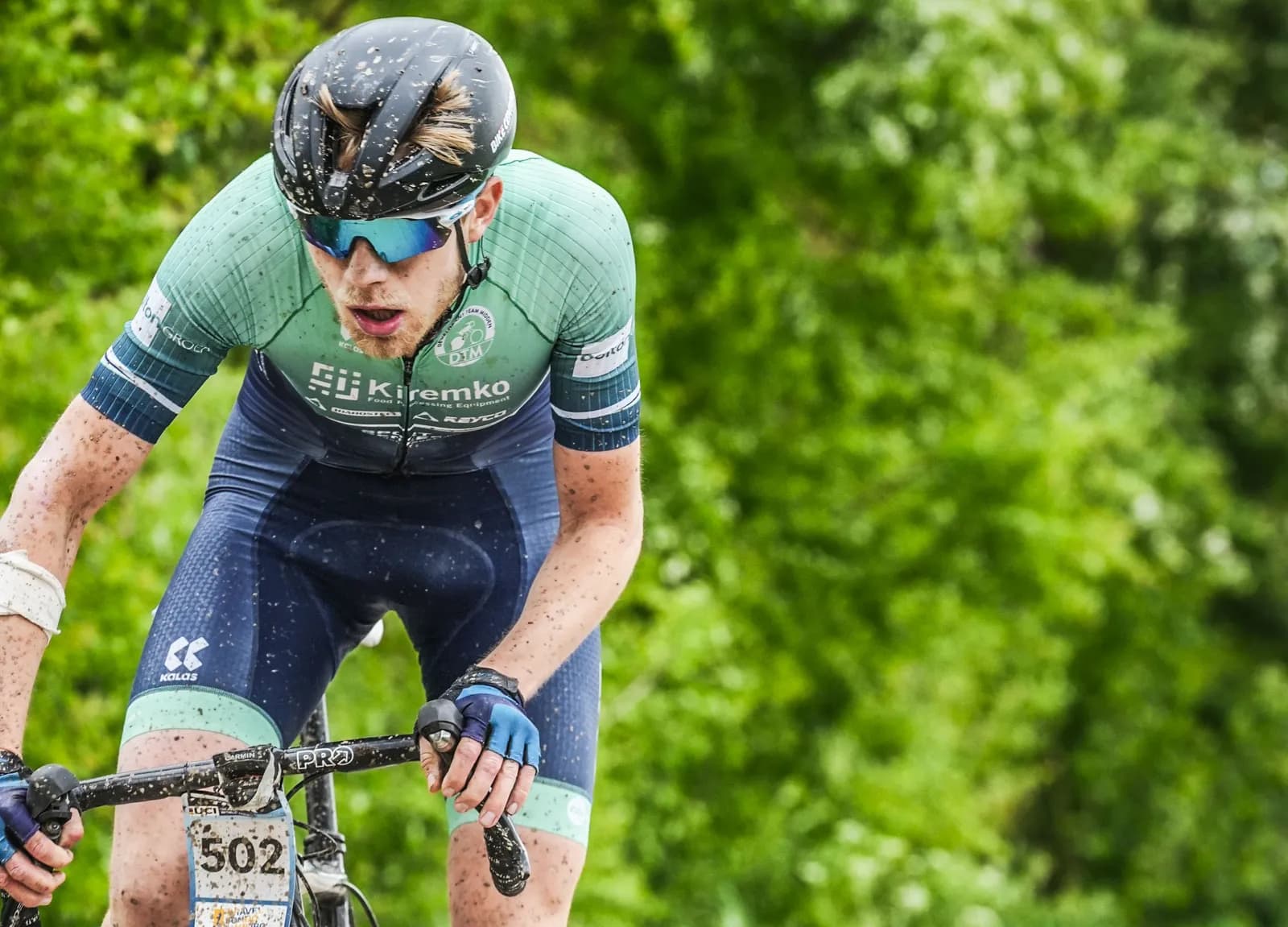
Two riders ride the same route, at the same power, in the same time. On paper they did exactly the same work. Yet they are left with a very different training dose. And the same rider can ride that route again two weeks later and respond differently once more.
That is why training load only becomes useful once you keep two things apart: external load, the work you carried out, and internal load, how your body responded to that work.
The distinction is meant to clarify the training process, not to produce two competing scores. Impellizzeri, Marcora and Coutts describe external load as the physical work from the training plan, and internal load as the psychophysiological response with which your body absorbs that work (Impellizzeri et al., 2019).
External load: what you did
On the bike that covers, for example:
- duration and distance;
- power and work in kilojoules;
- time in intensity zones;
- climbing, cadence and torque;
- repetitions and recovery periods.
That makes a session concrete. "Four times eight minutes at 290 watts" describes the stimulus better than "a hard ride". It is also the side a coach prescribes most directly.
But it does not say what dose you actually took in. A power meter measures the work, not how your body stood that day: how you slept, how warm it was, whether a cold was coming on.
Internal load: how you responded
On that side sits everything that shows how your body responded to the work: heart rate, blood lactate, oxygen uptake, session RPE (how hard the whole session felt) and subjective signals of fatigue or freshness. According to Impellizzeri and colleagues (2019) it is that response, and not the exercise itself, that provides the stimulus for adaptation.
For day-to-day coaching, heart rate and perceived exertion are strong simply because you have them for every session. Neither is perfect. Heart rate responds to heat and fluid loss, and creeps up over a long ride even when the power stays the same (cardiac drift). Perceived exertion is subjective, but subjective is not meaningless. A systematic review of 56 studies found that self-reported wellbeing moved consistently with training load: worse under heavier and sustained training, better when training eased off, and more sensitive than commonly used objective measures (Saw et al., 2016). That is about fatigue and wellbeing, though, not about performance.
So the question is not which meter is best, but what they say together.
Read them side by side
The most useful information sits in the ratio. If the same standardised work costs less internal load under comparable conditions, that points to better fitness; if it costs more, you may be losing fitness or carrying fatigue (Impellizzeri et al., 2019).
Take an easy endurance ride at a power you know:
- Heart rate and feel both normal: the ride probably cost what you expected of it.
- Heart rate higher at the same power: look at the conditions first, such as heat or fluid loss. If it is not warm, sleep, stress or a developing illness may play a part.
- Heart rate low instead, while it feels unusually hard: reason to look at accumulated fatigue. In male triathletes who became functionally overreached after a heavy block, maximum heart rate fell while their perceived fatigue rose (Aubry et al., 2015).
- The same power feels lighter, at a lower heart rate and in comparable conditions: then your fitness is probably growing.
None of those observations is a diagnosis. They give you reason to ask a better question and to follow the pattern over a longer stretch. How I lay external and internal load side by side is on my method.
Why one load score is not enough
Platforms squeeze duration and intensity into one convenient score, such as TSS, and build a fitness line on top of it. That is fine for summarising a week, but a precise number is not yet a precise prediction of what your body does with it.
Sessions with the same score can make very different demands. Two hours easy at 71% of your FTP and one hour flat out at your FTP both come out at roughly 100 TSS; that is how the formula is built. A long endurance ride, short sprints and threshold work are not interchangeable because their TSS happens to match.
Load does not automatically predict fitness either. The fitness line in your training platform is a calculation on your load scores, not a measurement of what is happening in your body. Impellizzeri and colleagues put it sharply: however sophisticated a load measure looks, if you cannot tie it to a plausible mechanism behind the response you are after, it is of little practical use (Impellizzeri et al., 2023). So a rising fitness line says you have done more work, not that your thresholds have moved. You see that only in the ratio between work and response, or in a test (in Dutch).
What you can do yourself
You do not need to be a movement scientist to use this. Ask yourself four questions after every session:
- Did I carry out the work I intended?
- How hard did the whole session feel, from 1 to 10?
- Was anything clearly different: sleep, heat, stress, pain or fuelling?
- How do I feel the next morning?
Note it briefly with your session in Intervals.icu or TrainingPeaks. Those few lines of context make your data readable. What I do with those answers as they come in is on my coaching.
External load tells you which stimulus you gave yourself. Internal load shows which dose your body experienced. Progress comes from steering that ratio, not from crowning one dashboard or fitness number as the truth.
Sources
Aubry, A., Hausswirth, C., Louis, J., Coutts, A. J., Buchheit, M., & Le Meur, Y. (2015). The development of functional overreaching is associated with a faster heart rate recovery in endurance athletes. PLOS ONE, 10(10), e0139754. https://doi.org/10.1371/journal.pone.0139754
Impellizzeri, F. M., Marcora, S. M., & Coutts, A. J. (2019). Internal and external training load: 15 years on. International Journal of Sports Physiology and Performance, 14(2), 270–273. https://doi.org/10.1123/ijspp.2018-0935
Impellizzeri, F. M., Shrier, I., McLaren, S. J., Coutts, A. J., McCall, A., Slattery, K., Jeffries, A. C., & Kalkhoven, J. T. (2023). Understanding training load as exposure and dose. Sports Medicine, 53(9), 1667–1679. https://doi.org/10.1007/s40279-023-01833-0
Saw, A. E., Main, L. C., & Gastin, P. B. (2016). Monitoring the athlete training response: Subjective self-reported measures trump commonly used objective measures: A systematic review. British Journal of Sports Medicine, 50(5), 281–291. https://doi.org/10.1136/bjsports-2015-094758